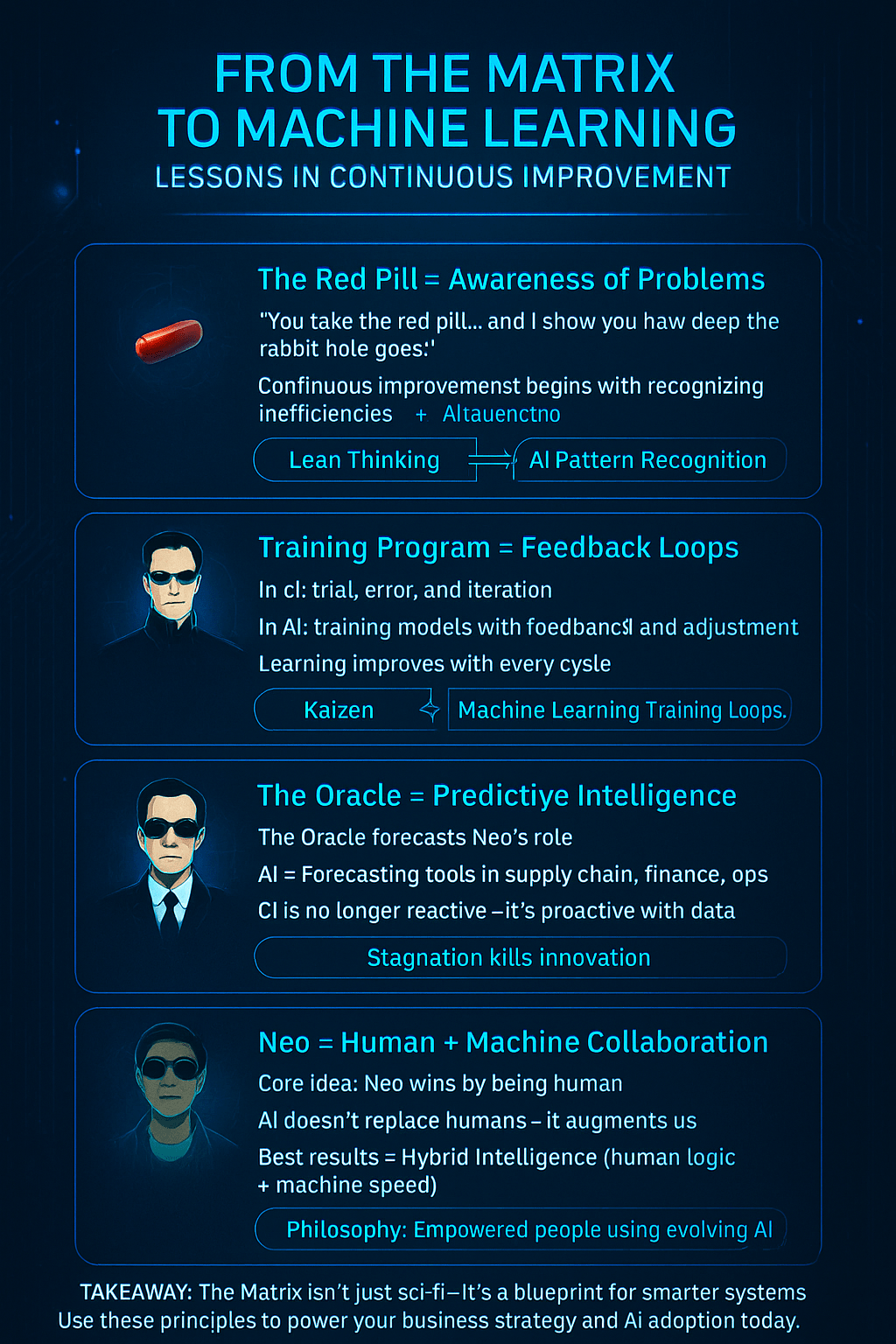
In 1999, The Matrix exploded onto screens with a provocative question: What is real? The film’s blend of philosophy, cyberpunk aesthetics, and dystopian AI narratives not only captivated audiences, it also inspired a generation of technologists and thinkers. More than just sci-fi entertainment, The Matrix planted seeds for continuous improvement and adaptive intelligence, principles that now form the bedrock of Artificial Intelligence (AI) development today.
The Red Pill: Awareness as the First Step to Improvement
One of the film’s most iconic metaphors is the red pill—choosing to awaken to the truth rather than remain in comfortable ignorance. This moment mirrors the first step in any continuous improvement methodology: awareness of the problem.
In Lean or Six Sigma, improvement begins when an individual or team acknowledges inefficiencies. Similarly, in AI, machine learning models begin their journey with data awareness. They learn by identifying patterns, recognizing errors, and adapting. Just like Neo begins to “see” the code behind reality, AI systems “see” trends in data and optimize themselves based on that vision.
The Training Program: Feedback Loops in Action
One of the most memorable aspects of The Matrix is Neo’s instant download of martial arts skills. While we haven’t reached that level (yet), the concept mirrors supervised learning in AI, where a system is fed labeled data and trained to make predictions.
Neo doesn’t just learn one move; he tests it, gets beat down, and adapts. These are feedback loops in action—core to both continuous improvement and AI. Whether it’s Kaizen in a manufacturing plant or backpropagation in a neural network, the goal is the same: improve with every cycle.
Agent Smith: The Cost of Resistance to Change
In the world of continuous improvement, resistance is inevitable. In The Matrix, this resistance is embodied by Agent Smith—a program designed to preserve the system. He resists evolution, adaptation, and freedom.
In the corporate world, “Agent Smiths” exist in the form of rigid processes, outdated systems, or leadership unwilling to change. AI, however, thrives on adaptation. Modern organizations that leverage AI must embrace continuous learning, automated decision-making, and the courage to disrupt themselves, or risk becoming obsolete.
The Oracle: Predictive Intelligence and Strategic Foresight
The Oracle isn’t just a fortune-teller—she represents predictive intelligence. In business, this is exactly what advanced AI offers: foresight through predictive analytics. Continuous improvement is no longer just about reacting to problems; it’s about anticipating them before they occur.
Today, AI tools utilize vast datasets and historical trends to forecast supply chain disruptions, detect anomalies in financial systems, and suggest optimal paths—all in real time. That’s the Oracle’s power, democratized.
The Chosen One: Human-AI Collaboration
Neo is powerful not because he’s a machine but because he’s human, guided by emotion, intuition, and moral choices. This is perhaps The Matrix’s most relevant message to AI development today: the future isn’t machines versus humans. It’s machines with humans.
Continuous improvement in AI isn’t about eliminating humans from the loop—it’s about augmenting human capacity. The most effective systems today are those in which humans and machines learn from each other, creating hybrid intelligence that evolves beyond the capabilities of both.
Disclaimer & Copyright Notice
This infographic is for educational and commentary purposes only. All characters, names, and imagery referencing The Matrix are the property of their respective copyright holders (© Warner Bros. Entertainment Inc.). This content is not affiliated with, endorsed by, or sponsored by Warner Bros. Any trademarks or copyrighted material used are employed under fair use guidelines for the purpose of analysis, education, and commentary.
References
Womack, J.P., & Jones, D.T. (2003). Lean Thinking: Banish Waste and Create Wealth in Your Corporation. Free Press.
This foundational book introduces the principles of Lean Thinking and continuous improvement (Kaizen), which align with the feedback loops and problem-awareness themes explored in the article.
Russell, S., & Norvig, P. (2020). Artificial Intelligence: A Modern Approach (4th Edition). Pearson.
A leading academic text that explains how AI systems learn from data, train models, and use predictive analytics—concepts mirrored in The Matrix-inspired narrative of learning and adaptation.







 Lean Finance and Operations
Leave a comment